Waste heat secures the growth of Vaggeryd
District heating connections in the Swedish town of Vaggeryd have grown by over 60% in recent years. To keep up with the increase in demand, waste heat from pulp manufacturer Waggeryd Cell plays an important part. Vaggeryds Energi has also built a new heating plant and a new accumulator. FVB was responsible for designing the district heating grid and conducted key calculations of the waste heat flow.
Vaggeryd Municipality in Småland in southern Sweden has become a logistics hub, with storage facilities built since 2020 covering over 200,000 square metres. An additional 260,000 square metres is also potentially available. The massive interest from companies wanting to establish themselves in the municipality is due to its excellent geographical location, close to the E4 motorway and the railway.
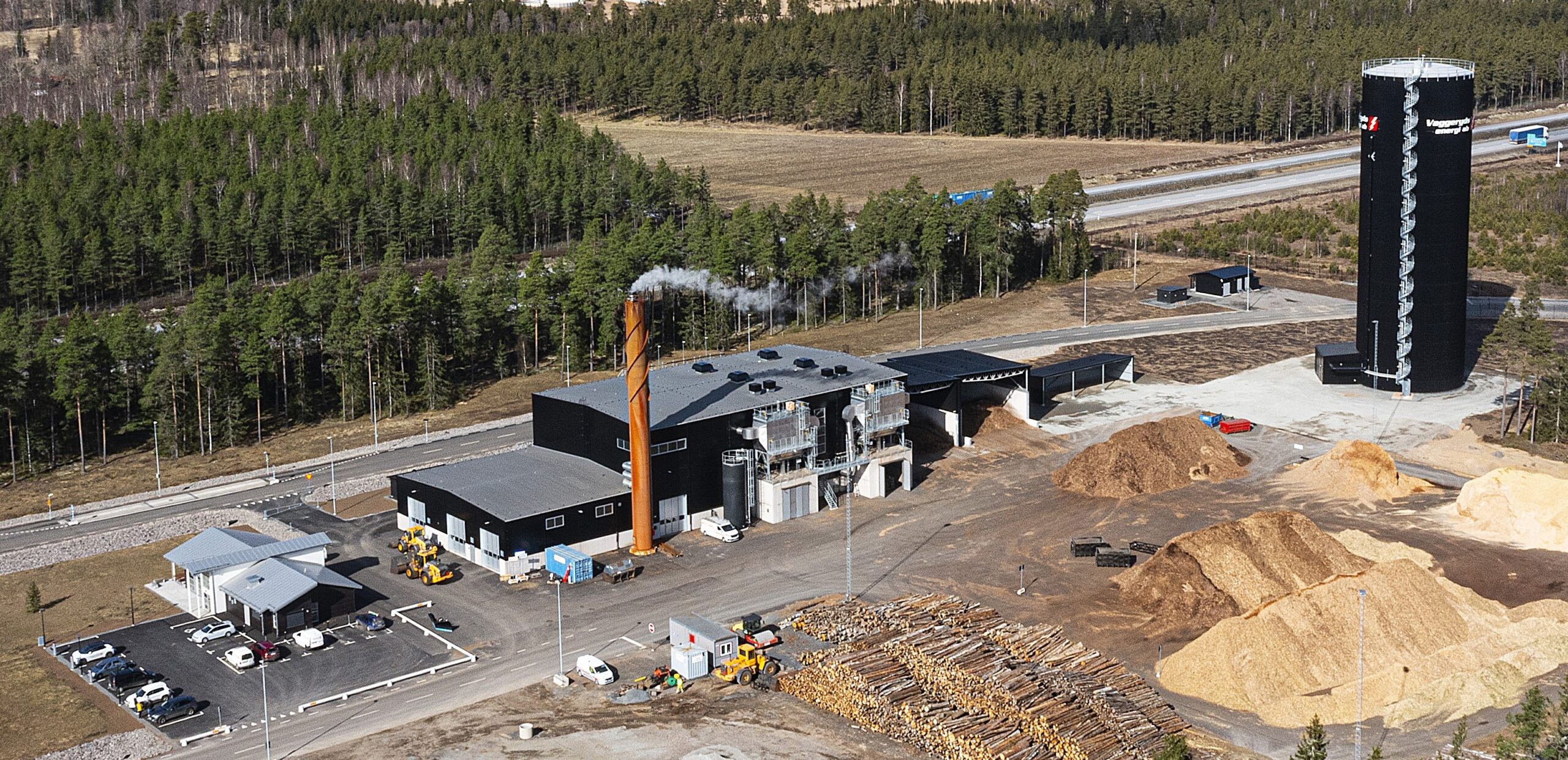
The heat production at Vaggeryds Energi required considerable changes because many of the community’s new buildings needed district heating, while existing facilities were ageing. FVB won a contract some years ago to study various alternatives for heat production, the outcome of which was the building of a biofuel heating plant on a new site between the communities of Vaggeryd and Skillingaryd, which was opened in May this year.
FVB was also responsible for designing the district heating grid, totalling seven kilometres. By building a new heating plant, the energy provider has been able to phase out the old heating plants at Vaggeryd and Skillingaryd. As a consequence of moving the heat production to a new site, Vaggeryds Energi had to completely change the flow in its grid.
“A lot of construction work on the grid has been necessary. We also had to decide how big the pipes should be, where in the grid they had to be installed for maximum efficiency and where we needed to rebuild the existing grid. We asked FVB to help us create a district heating system that works as a whole, which it now does,” says Peter Waldenström, District Heating Manager at Vaggeryds Energi.
The site of the new heating plant is close to Waggeryd Cell.
“We entered a collaboration with Waggeryd Cell so that their waste heat could supplement our own production. According to our estimates, about 50% of our energy could come from waste heat in the future,” explains Waldenström.
Waggeryd Cell manufactures paper pulp from wood chips. During this process, the chips are broken down, boiled and then dried. A lot of energy is required, generating high levels of waste heat. Even though some of that heat is recycled internally in the process, there is a large surplus, which used to be discharged into the Lagan River, but that can now be used in the local district heating grid. The total amount reaches 6–8 MW per year.
Between May and September, the grid can run solely on waste heat. The collaboration with Waggeryd Cell includes a new accumulator (8,500 cubic metres), sufficient to cover heat requirements for 2–3 days. Waldenström believes that the accumulator was a decisive element in being able to shut down heat production during the summer, as it can even out any fluctuations in waste heat supply. This year has been the first in which the system ran solely on waste heat during the summer, and was a complete success:
“We receive heat at 80 degrees from Waggeryd Cell, sufficient for most of the summer. We also opted for a flexible solution that makes it possible to extend the period by using surplus heat from their steam boilers,” says Waldenström.
“Waggeryd Cell were initially a little hesitant about us using their waste heat, as they had no idea what it might entail, thinking it could affect their core business. But by creating a system with as little impact as possible on their processes, we achieved an excellent solution,” explains Waldenström.
FVB played a key role here, running a series of simulations of various flows, temperatures and pump capacities.
“Without affecting their process too much, we were able to propose changes that transfer surplus heat and release other heat the company can now sell,” states Johan Söderberg of FVB, who has been responsible for waste heat calculations.
Surplus heat from the industrial process is transferred to the district heating system using heat exchangers.
“A lot of calculation work and tests were needed, enabling us to arrive at a solution that consists of two heat exchangers for waste heat and one for steam from the boilers, resulting in very high flexibility,” explains Söderberg.
In technical terms, the solution has worked well. The environment also benefits according to Vaggeryds Energi, cutting carbon dioxide emissions from heat production by around 5,000 tonnes per year. The initiative was awarded the Jönköping County Climate Council’s Climate Conservation Award 2024.
More information:
Johan Söderberg, 08-5947 61 78