How to make district cooling profitable – Swedish models are drawing interest
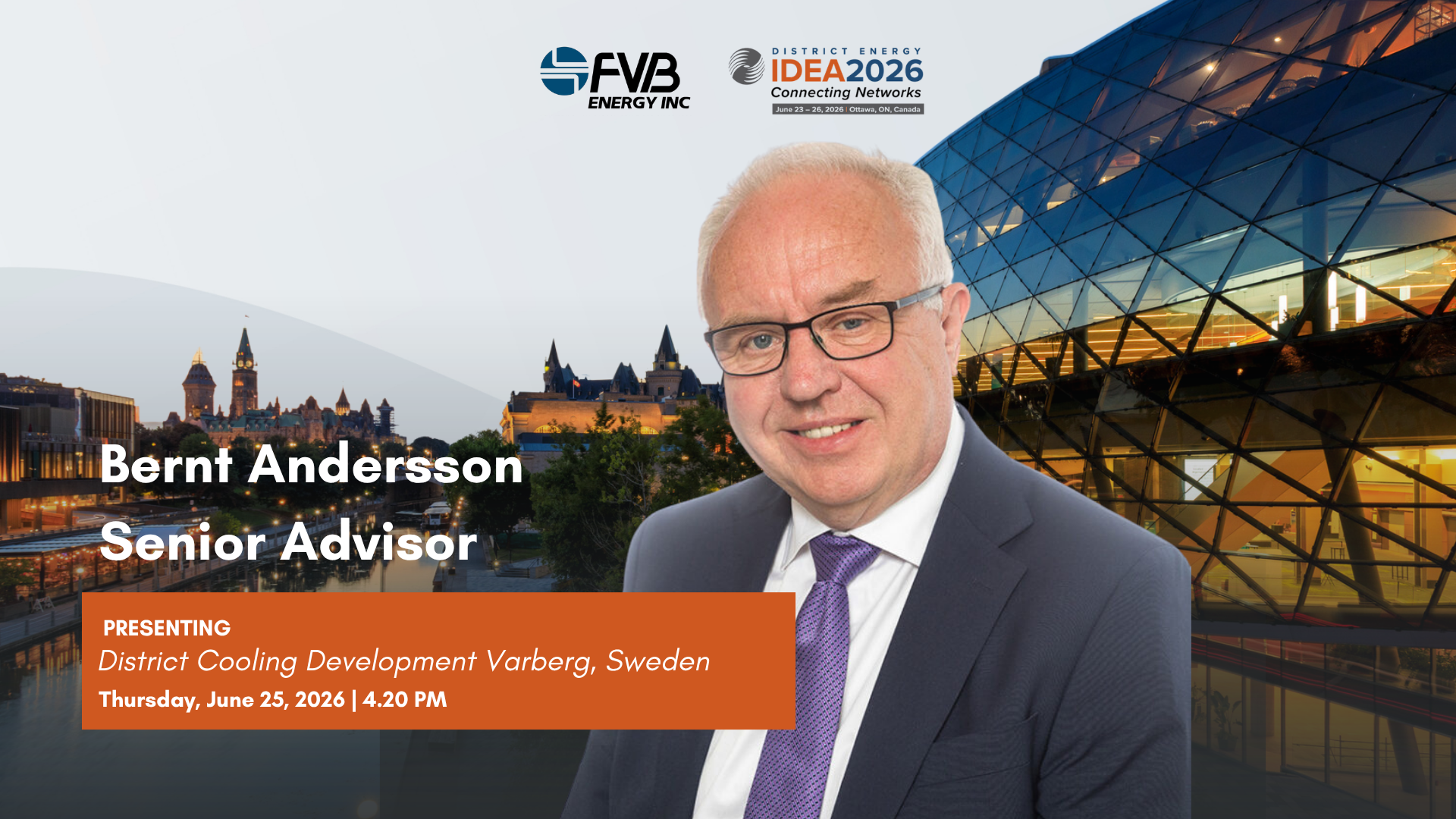
Small district cooling systems can be profitable – if the conditions are right. This is the message Bernt Andersson at FVB is taking to IDEA2026, one of the world’s largest conferences for district heating and cooling. His focus will be on Varberg Energi’s district cooling initiative, which he is the main project manager for.
“District cooling in Varberg is being expanded with a relatively large district cooling network with good economic conditions, despite a fairly low cooling demand with potential customers. There are only a few customers with cooling needs beyond 500 kW. This is in major contrast to markets in North America and China, which require much larger customers,” says Bernt Andersson.
He has extensive international experience in district cooling expansion from Canada, the United States, China and the Middle East. He is currently working at FVB’s office in Västerås and is also Chair of Sweheat and Cooling China Chapter.
“In many countries, district cooling is its own industry with much higher return requirements than what energy companies in Sweden have. In those countries, the cooling systems need to be very compact and have large customers to make such investments profitable,” says Bernt Andersson.
“In Sweden, however, there are established district heating companies, and they can achieve synergies by also offering cooling. They also run the risk of losing heating customers if they cannot offer both heating and cooling. Energy companies in Sweden also view district cooling as an important infrastructure investment and not just a business project,” he says.
At IDEA2026, taking place 23–26 June 2026 in Ottawa, Bernt Andersson will promote Varberg Energi’s district cooling initiative.
The energy company in Varberg will primarily use geocooling from the sea during late autumn/winter and spring, and they will also use sea water for cooling condensers on the cooling machinery. In addition, they will use absorption cooling that utilise surplus heat from Värö Bruk.
“In the end, this means that the district cooling project is very environmentally friendly, and it’s a pleasure to promote this initiative at an international conference with visitors from all over the world,” says Bernt Andersson.
The environmental aspect is an important factor for customers when choosing district cooling but also avoiding noise and not having to handle coolants.
“Many companies use their own cooling machinery, but the equipment emits condenser heat into the air, which often results in increased temperatures in cities. In Varberg, this heat is instead diverted into the sea, but the volumes are so small that it does not affect the marine environment,” says Bernt Andersson.
The first customer, which is the city’s hospital, is expected to be connected in 2027. Bernt Andersson does not think that the project poses major challenges from a technical standpoint. What does make it difficult, however, is that it requires coordinating technical solutions, constructing facilities and marketing to and connecting customers. All this has to be done in parallel and be completed at the same time.
For more information:
Bernt Andersson +46 (0)21 81 80 60
